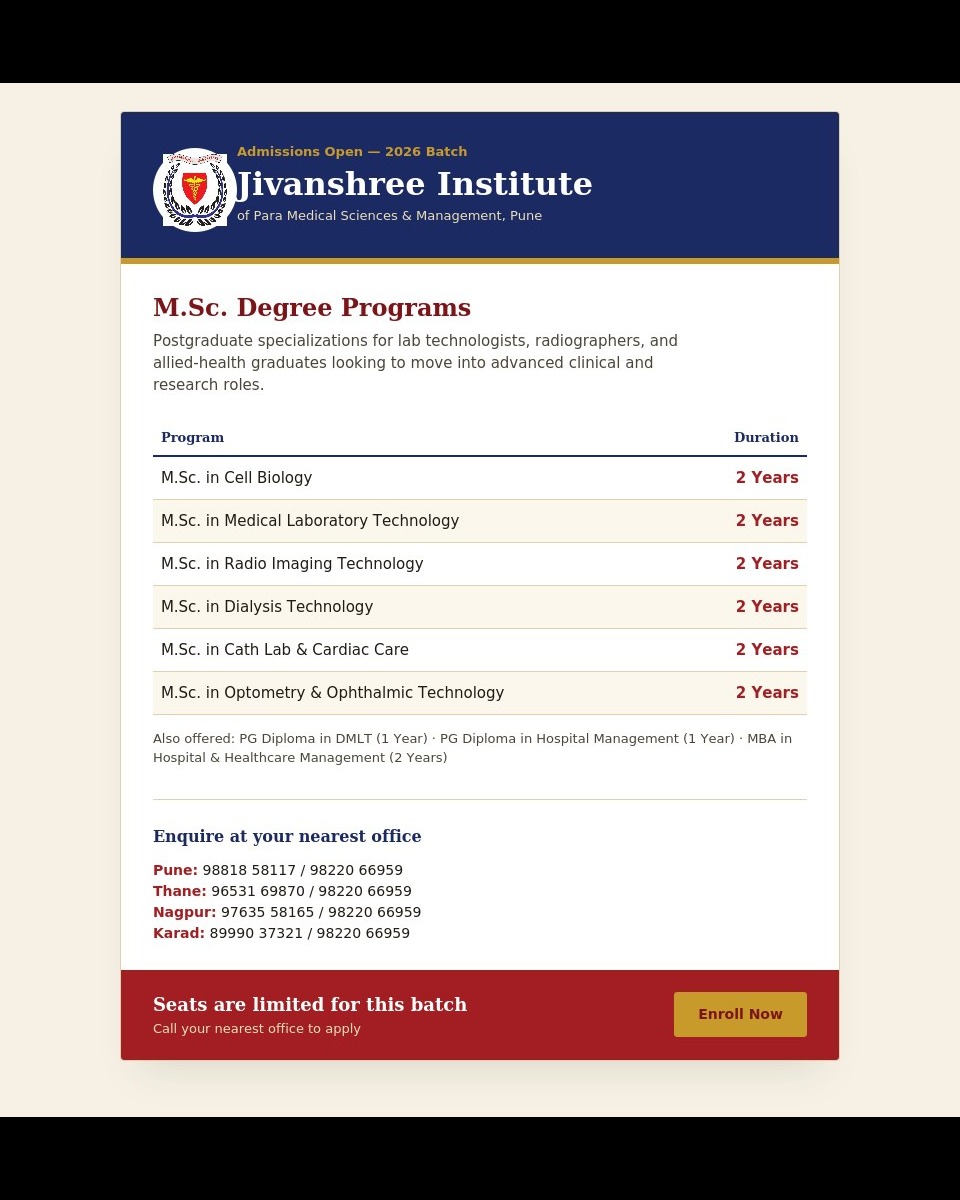
M.Sc. in Cell Biology (2 Years)
This program focuses on the structure, function, and behavior of cells at a molecular level, covering areas like cell signaling, genetics, molecular biology, and laboratory research techniques. It's suited to students who want to move into research, diagnostic laboratories, biotechnology, or teaching roles, and often serves as a stepping stone toward further research or a PhD.
M.Sc. in Medical Laboratory Technology (2 Years)
An advanced continuation of lab technology training, covering specialized diagnostic techniques in clinical biochemistry, microbiology, hematology, and pathology. Graduates typically take up senior lab technologist, lab supervisor, or quality-control roles in hospitals, diagnostic centers, and pathology labs, and it also opens doors to lab management or teaching positions.
M.Sc. in Radio Imaging Technology (2 Years)
Builds on undergraduate radiography training with advanced study of imaging modalities such as X-ray, CT, MRI, and ultrasound, along with radiation safety and image interpretation support. It prepares graduates for senior radiographer, imaging department supervisor, or technical trainer roles in hospitals and diagnostic imaging centers.
M.Sc. in Dialysis Technology (2 Years)
A specialized program covering renal physiology, dialysis machine operation and maintenance, patient care during dialysis, and management of related complications. It's aimed at students who want to work as senior dialysis technicians, unit in-charges, or trainers in nephrology and dialysis centers.
M.Sc. in Cath Lab & Cardiac Care (2 Years)
Focuses on cardiac catheterization procedures, cardiovascular diagnostics, and patient management in cath labs and cardiac care units. Graduates are prepared for roles as senior cath lab technologists, cardiac care coordinators, or supervisors in hospital cardiology departments.
M.Sc. in Optometry and Ophthalmic Technology (2 Years)
Covers advanced eye care, vision science, diagnostic techniques for eye disorders, and ophthalmic equipment handling. It's designed for those aiming to work as senior optometrists, ophthalmic technologists, or in specialized eye-care and vision-correction settings, and can also support roles in optical research or academia.