
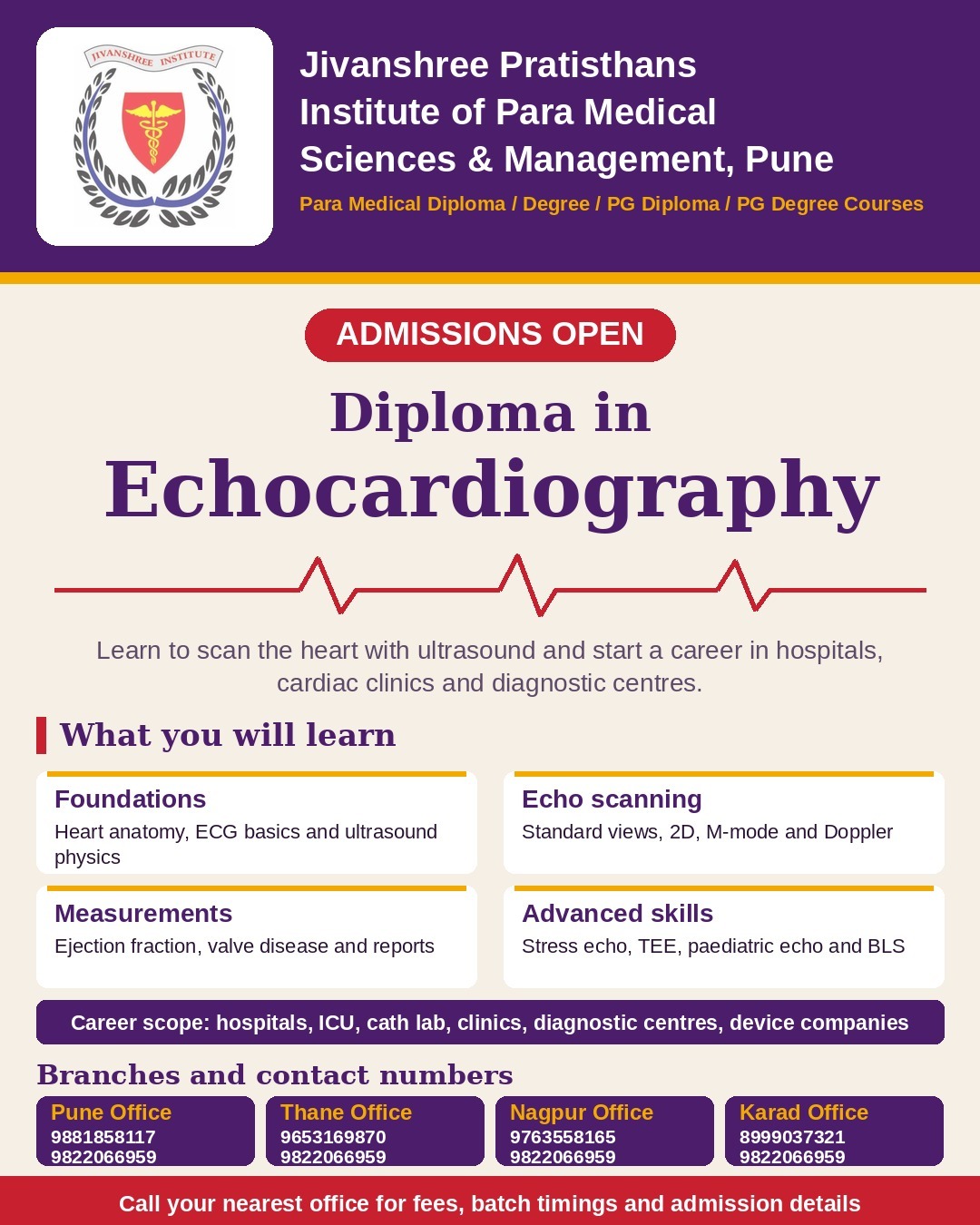
Diploma in Echocardiography
An echocardiographer (echo technologist/sonographer) uses ultrasound to image the heart, measure how well it pumps, check the valves, and detect problems like heart failure, valve disease, congenital defects, and fluid around the heart. A cardiologist interprets the final report, but you do the scanning and often prepare the measurements.
Where you can work
Hospitals (cardiology departments, ICUs, cath labs)
Diagnostic centres and cardiac clinics
Private cardiologists' practices
Mobile/home echo services
Medical device companies (application specialist or trainer roles)
Abroad (Gulf countries, UK, Australia, Canada, etc.), though these usually require extra registration or exams like ARDMS or CCI
Growth path
Echo technician → senior technician → specialist in stress echo, TEE, pediatric echo, or fetal echo → department in-charge, trainer, or applications specialist.
what you will learn..
Cardiac anatomy and physiology
Basics of the ECG and cardiac cycle
Ultrasound physics (sound waves, transducers, image quality, artifacts)
Common heart diseases and their causes
Core echo skills
Standard views: parasternal long/short axis, apical 4-chamber/2-chamber/3-chamber, subcostal, suprasternal
2D echo and M-mode
Doppler: colour, pulsed wave, continuous wave, tissue Doppler
Measuring chamber sizes, ejection fraction, wall motion, valve gradients, pulmonary pressures
Assessing valve stenosis and regurgitation
Recognising cardiomyopathies, pericardial effusion, clots, and congenital defects
Advanced (adds to your value)
Stress echo
Transesophageal echo (TEE)
Pediatric and fetal echo
Contrast echo and 3D echo/strain imaging
Practical and professional skills
Patient handling, positioning, and communication
Machine operation and basic maintenance
Report preparation and documentation
Infection control and basic CPR/BLS